
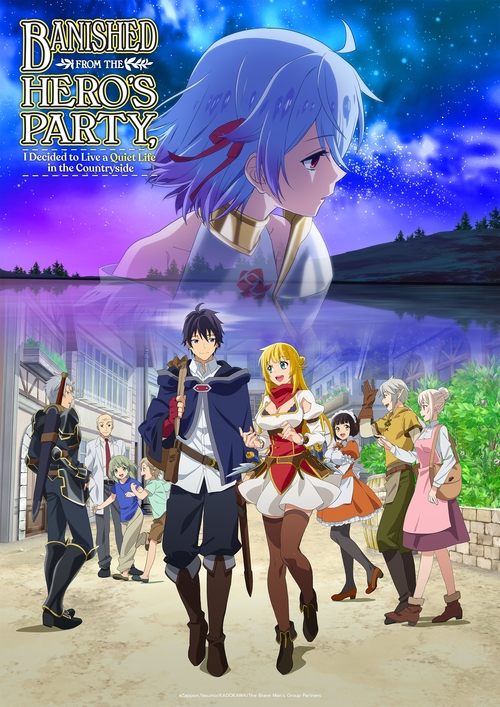
In the world of Isekai anime filled with overpowered heroes sent to fantasy worlds to defeat demon lords, 'I Got Kicked Out of the Hero's Party, So I Decided to Slow Life at the Border' (真の仲間じゃないと勇者のパーティーを追い出されたので、辺境でスローライフすることにしました) dares to be different. It has the hero kicked out of the party and choosing to start a simple, heartwarming life. This series not only offers lighthearted adventure but also weaves in themes of self-worth and finding happiness in one's own way.
Story Summary (No Spoilers for the Ending)
The story takes place in a world where everyone is born with a 'blessing' that determines their occupation and abilities. Red (or Gideon) is a former leader of the hero's party fighting against the demon army. Although his blessing is merely 'Herbalist,' seemingly useless in battle, his dedication and outstanding leadership earn him respect from his teammates. However, when his sister, Ruti, who has the 'Hero' blessing, begins to display immense power, party members—especially the sage Ares—start seeing Red as a burden and eventually expel him from the group.
After being kicked out, Red does not grieve or seek revenge; instead, he sees this as an opportunity to live a peaceful life as he desires. He travels to the frontier town of Zoltan, opens a small pharmacy, and enjoys a slow life with Rit, a girl who follows him. Meanwhile, the original hero's party begins to face internal strife, especially as Ruti starts losing her emotions due to the hero's power. The story unfolds on both sides: Red's peaceful life and the hero party's turmoil.
Performance and Characters
The main voice actors deliver outstanding performances, especially Ryota Suzuki as Red, with a warm, calm voice that conveys maturity and tranquility. Meanwhile, Kanon Takao as Rit perfectly captures the cuteness, brightness, and loyalty of the girl who stays by Red's side.
Every character has interesting development. Ruti (voiced by Naomi Ohzora) is the hero sister who gradually loses her humanity due to her blessing, creating compelling internal conflict. Ares (voiced by Taku Yashiro), the sage who expelled Red, is not a one-dimensional villain but has his own reasons and pressures, adding depth to the story.
Direction, Visuals, and Music
The series is produced by studios Wolfsbane and Studio Flad. The visuals are generally good, with beautiful and soothing rural slow-life scenes that convey peace. However, battle scenes are few and sometimes use CGI that can appear stiff.
The music, composed by Yuki Hayashi and Yoshihiro Ike, creates an appropriate atmosphere. The opening theme 'Hikari' by Ayane Sakura feels refreshing, while the ending theme 'Michi' by Kanon Takao is warm and fits the series' theme.
Editorial Analysis
The editorial team sees the series' strength in presenting the concept of 'finding self-worth' that does not have to be tied to ability or social status. Red chooses to be happy in his own way, even if seen as 'useless' by others, proving that a seemingly inferior blessing can meaningfully help people.
Moreover, the series questions the 'blessing' system that predetermines one's fate—whether it is fair, and how being boxed in by innate traits reflects a society that values 'special abilities' while overlooking the value of effort and determination.
However, the pacing in some parts may be too slow for those expecting intense action, and the focus on Red's daily life might bore some viewers. Overall, this series is suitable for those looking for something relaxing, heartwarming, and thought-provoking.
Verdict
For those tired of heavy action anime and looking for something chill and thought-provoking, 'I Got Kicked Out of the Hero's Party, So I Decided to Slow Life at the Border' is a heartwarming choice. Though lacking intense action, it has its own charm, suitable for slow-life fans and anyone seeking a series about the value of being oneself.
Screenshots


👍 Pros
- +Creative concept focusing on slow life after being kicked out
- +Characters have depth and clear development, especially Ruti
- +Music and opening/ending themes are pleasant and fit the atmosphere
- +Themes of self-worth and living happily
👎 Cons
- −Few battle scenes and CGI can be stiff at times
- −Slow pacing may not appeal to action lovers
Top Cast





FAQ
The series has a total of 25 episodes, split into 2 seasons, with a complete ending in season 2.
Yes, but it's a reverse Isekai: the protagonist is sent back to a peaceful fantasy life after being expelled.
There is similarity in the protagonist being expelled from the party, but the approach differs: Shield Hero focuses on revenge, while this series emphasizes slow life.


